
After an incredible win over the South African cricket team in Southampton, we were on a high as we continued our Road Trip towards Portsmouth. The Historic Dockyard awaited and we were looking forward to a few days exploring.
Our tickets purchased with Tesco Clubcard vouchers (thank you Mr Tesco) would normally cost £48pp, and covered unlimited entry for 12 months. We were hoping to cover all bases in our three day trip, but if not, there was the option to return.
- Harbour Tours: As one of the boat trips offering views of modern Royal Navy warships, was about to depart, we decided to have a leisurely start to our visit. The harbour is still in constant use, with Naval Ships docking, for restocking, refuelling, and minor repairs. With two dry docks being used for more major repairs on ships from around the World. During the Summer months cruise ships also bring thousands of visitors to enjoy all that Portsmouth has to offer
Across the other side of the harbour is a marina, hosting the local yacht club and visiting boats. It is almost encompassed by and incredibly long pier. We pootled passed the great sea forts, and made a short stop at Gunwharf Quay, looking up towards the spectacular Spinnaker Tower, surrounded by beautiful blue skies.


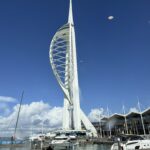
Having circled the harbour we arrived back on terra firma, ready to continue our tour.
- HMS Victory: Lord Nelson’s flagship at the Battle of Trafalgar, was obviously the first point of call. She is currently undergoing a huge restoration, which is likely to take 20 years to complete. However it is possibly an ideal time to visit as you can, climb the scaffolding and see the intricacies of its frame up close. 90% of her original frame was made of oak, making it not only beautiful but strong enough to hold the 104 guns.


Whilst the work continues on the frame, you can still enjoy a trip back in time and wander around the decks. The mighty guns are still in situ, standing to attention, their muzzles peeping out the side of the ship, ready for action. The huge double wheel, greeted us as we headed through to Lord Nelsons quarters, where he ate, slept and plotted strategy during battle. Out on deck more canons were guarding the ship, with their canon balls lined up and ready for action.


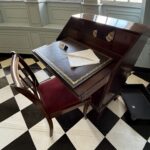

Back down below, we discovered the life of a sailor, surrounded by more canons with hand guns close to hand too. The heat of the kitchens must have been intense and meals were taken in small groups in the vicinity of their stations. Hammocks hung amongst the ships ropes, meaning they were never far away should they be called to duty.


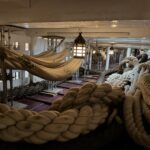
In stark contrast the officers quarters were more lavish, with proper washing facilities and a more comfortable toilet, albeit that it emptied straight out to sea! Their beds gave them more privacy and their working conditions more sedate.


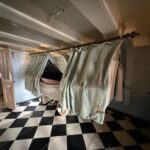

On the lower deck, a plaque marks the spot, where Nelson supposedly spoke his famous last words “kiss me Hardy”. It appears he passed in the depths of the ship, close to where seamen were working making ammunition and repairing firearms.


As we ventured outside, we could view repairs being undertaken on the hull of the ship, giving an insight into parts that would normally be below the water.
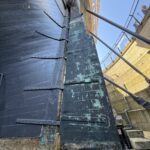


Despite parts being shrouded in scaffold and sheeting, it was an incredibly interesting tour of the longest serving ship in the Royal Navy, still being in commission some 248 years since its launch.
- HMS M33: A gun ship built in 1915. The ship looks tiny, sitting alongside HMS Victory, but has had an impressive work life. Initially seeing active service in the Mediterranean in WW1, becoming a mine-laying training ship, a net laying ship, used to lay and maintain steel anti submarine or anti torpedo nets. Finally a floating office, before retiring to become a museum.


Everything aboard is compact in comparison to HMS Victory. But the quarters still house hammocks for sleeping, although the dining area is a little more comfortable sitting away from guns and huge stoves unlike the larger ship.
- HMS Warrior 1860: The Royal Navy’s first iron-hulled, armoured battleship. This beautiful ship was only in service for just over 20 years, and spent its active life with the Channel Squadron, protecting our shores from the French.
It houses a spectacular armoury, including pistols, rifles, swords and of course canons. Travelling under steam, the engine room must have been the worst part of the ship in which to work. The kitchens were slightly enclosed, but the dining tables were still nestled amongst the guns. And unless you were an officer, sleeping was in a hammock hanging from the rafters.


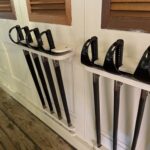


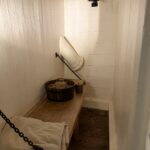


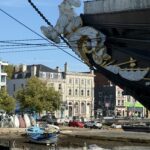

Everything aboard has been superbly preserved. A moment in history captured for future generations to enjoy.
Our first day in Portsmouth was drawing to a close and with our hotel just a short walk away, we were ready for dinner and a relaxing evening.
We decided to start our second day, exploring Portsmouth itself and with the help of one of the brilliant mystery guides, we made our way to the sea front. As we solved clues, we took a two hour tour of this lovely City, down lanes, through churchyards, along passageways, discovering things we would never have known were there. From a skull above the church doorway, to a golden lion standing guard over a house, to a triple decker boat store, until we arrived at our destination, which as usual was a pub.


However it was quite busy so we headed to a pub at Gunwharf Quay, for refreshment. We thought we had found the perfect spot, in the sun looking over the water, until the Isle of Wight ferry went by, causing huge waves which breeched the wall, soaking us in the process.


Thank goodness the sun continued to shine and dry us out as we strolled back towards the dockyard.
- The Mary Rose Museum: Houses the remains of Henry VIll’s favorite ship, which sank in 1545. A specially built facility is now home to this most famous of ships. We journeyed through an interactive exhibition telling us its story. Artefacts retrieved from the sea bed have been restored and are now protected behind glass in an amazing exhibition. It is a surprisingly large collection, considering the length of time the ship languished in the sea before its discovery.
Pewter plates and jugs, were displayed alongside wooden bowls and plaques, all remarkably in tact. Information and pictures explaining what life would have been like aboard. We climbed the stairs to be greeted by the ships bell, small in comparison to the size of the ship.


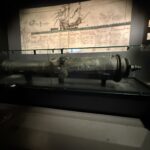
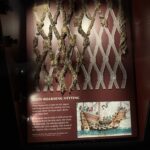
Then as we turned the corner, there she was. Oh my goodness, the sight of her laying in dry dock took your breath away. The display is mesmerising and to help you understand life on board, different areas of the ship light up, intermittently showing animation of how the crew might be working in that area. We travelled over several floors, transfixed as we followed each level of the ship, giving us different views as we climbed, with the displays behind showing contents which may have been on that particular floor.


With lighting that cleverly enhances the display, we were entranced for almost an hour. One of the most special exhibitions I have ever seen.
- National Museum of the Royal Navy: Showcases the history of the Royal Navy with a focus on Nelson in the Nelson Gallery. The air filled with stories told by Naval men and women across the years. Memorabilia from naval ships is displayed through three storage houses and takes us on a voyage through history from Nelson to modern day arms and vessels.


We learned about how ships biscuits could last so long. the contents of grog and the bed bugs and weevils that lived alongside the sailors. Life could be very grim.
As we ended another very full day at the dockyard, we were a little weary, but it had been a fabulous journey through time, with the Mary Rose exhibition leaving me breathless.
Our final day looked as though it might be very damp, but undeterred we donned our wet weather gear and got ready to venture out. Planning on a boat trip to part of the dockyard on the other side of the harbour, we hoped that the weather wouldn’t disrupt the ferry.
- Royal Navy Submarine Museum: We started our day taking a journey through War Time Britain, discovering the work undertaken to support the war effort, by those unable to join the front line, women and engineers. It is an interactive museum, as we opened locker doors we heard the story of the wartime life of factory workers. Pushing buttons we learned about the munitions factories and how it felt taking cover in Anderson shelters.


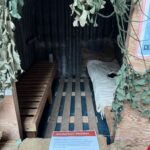
There was a very large collection of weapons and ammunition, representing several nationalities, some from the war but others that were still regulation during the hubby’s army life. We wandered into a room with various types of under water mines, the bleep bleep sound of sonars filling the air. Some were bobbing up and down to show how they hid just below the surface of the waves, others cut in two to explain the inside workings.


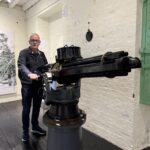


- Explosion Museum of Naval Firepower: We moved on to this unique display, located in a former gunpowder depot. It showcased missiles, torpedoes, and naval weaponry. The shells standing proud, were huge. I’m not sure how they were physically loaded into the guns. The guns themselves were massive and must have taken great skill to ensure the targets were hit.


From there we were faced with an impressive room of torpedos. They came in all shapes and sizes, some with fins, some without, some with tails whilst others slimline. They were fired in a variety of ways, but impressive as they were they were all deadly. I hadn’t realised there were so many different types.


Within the museum is a vast vaulted room, with 8ft thick brick walls. It was built around 250 years ago to store up to 6200 barrels of gunpowder. The room needed to be cool and dry, hence the thickness of the walls. There are vents to keep the air at a constant temperature. It now just holds a couple of displays and is used as an events room.


The Night Hunters gallery: holds smaller boats used by the RN Coastal Forces during the war, They were used for high risk operations to protect the coast of the UK. We were able to climb aboard some of these boats, to get a feel of how compact they were. The gallery also holds the stories and medals from some of the men who crewed them.
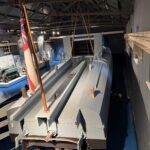


- HMS Alliance: a Second World War-era submarine: This is one of the main attractions on this site. It is our only surviving WW2 submarine. Built in response to the attack on Pearl Harbour, which brought the USA into the war, she not only served in WW2 she was used to protect our shores during the threats of the Cold War.
Now standing as a museum, most of her equipment is still in tact and we were taken on a tour by a very knowledgeable guide. We learned of the working of a submarine, how it dives and how it comes back to the surface. The noises of the machines beeping and intermittent crew conversations, as we made our way through.


The areas for relaxation are as they were, with office space and bathroom facilities. The toilet was like a computer room with lots of pipes and wires. The flush looking like a one armed bandit handle!


The space to walk from room to room was very narrow and must have been incredibly noisy and hot. In the main control room we were able to take a peek through the periscope as we heard how the sub was controlled with no visuals just instructions from the Captain 😳
At the bow we found where the torpedos were stored and how they were loaded ready for firing when necessary.


A great, informative day, learning how our fellow Britains fought and survived the War. As we waited for our ferry back to the dockyard, there was time for a spot of naval dressing up.

Portsmouth Historic Dockyard was a wonderful 3 day trip back in time. There are lots of areas for both adults and families. It is reasonably priced, especially considering your ticket lasts 12 months, and of course even better if you use Tesco Clubcard Reward Vouchers.
Having been to Portsmouth on a couple of previous occasions, we mainly concentrated on the Dockyard, but there is a lot more to see in this lovely City.