
On many occasions, we have pondered about heading across to France, for a road trip to explore the D Day landing beaches and pay our respects, at some of the many War Cemeteries.
2024 has seen the 80th anniversary of D Day and tv coverage brought a trip once again to the fore front of our minds. We had been thinking we might make the trip in 2025, but when we saw that there was going to be a temporary installation, called Standing with Giants, at the British Normandy Memorial, we felt had to make the journey this year.
Our original plan was to take our car, however when we started investigating, we noticed one of the large coach companies were undertaking a trip, which would cover everything we wanted to see, with none of the navigation friction 😬, it seemed perfect.
The journey down to our hotel in Falaise was going to be an all day affair, but with neither of us needing to drive, we sat back, enjoyed the views, got to know the people sitting around us, snoozed a bit, nibbled on the snacks we’d packed and made use of the comfort breaks along the way.
The hotel was fairly basic, but adequate and comfortable. The included breakfast was good, the additional evening meals were ok, but the staff were very friendly and the bar was open 24/7 👍. Like most budget hotels it was a 20 minute walk if we wanted to head into Falaise. However we were expecting early starts and long days, to cover all that was promised, so it wasn’t going to be an issue.
6th August:
During our first day of touring we were going to be learning about the British and Canadian involvement on 6th June 1944
Operation Overlord had been a long time in preparation, with lots of fake documents, coded radio messages and strategic bombings over Calais, to make the Germans think the Allied invasion was going to be in the Calais area.
In fact the invasion came via Normandy and originally planned for 5th June, but delayed due to poor weather. The initial attack was to take Pegasus Bridge. Six gliders flew across the Channel and silently landed in fields beyond the bridge. With only two sentry’s on guard the two bridges were soon taken, securing a crossing over the River Orne and Caen Canal, for the Allied troops expected to arrive in the coming days.
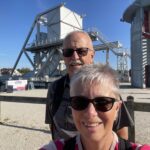


During our guides talk, the bridge lifted to allow a boat to pass along the canal, and our attention was largely diverted towards the spectacle 😬
He didn’t seem too perturbed and after we’d taken videos and photos, he took his gang across the road to explore the Pegasus Memorial Museum, which is dedicated to the soldiers of the 6th British Airborne Division.
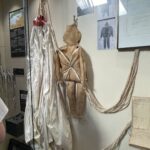
The museum houses lots of military memorabilia, from uniforms, to weapons, tools to parts of gliders. A fascinating collection. Outside there were military vehicles all standing to attention as we passed on by.



At the centre stands the original Pegasus Bridge, which you can walk across and a Bailey Bridge, used by the Royal Engineers to erect speedily where river crossings were needed.


It is also home to a restored glider, which gives you an insight into the cramped conditions during the flights across the Channel. There were no seatbelts and as the gliders came down to earth, the men had to link arms to brace themselves and lift their legs to avoid them being crushed 😳. Amazing they survived the crash landings.


At our allotted time we re boarded our coach. A couple of naughty stragglers delayed our departure for Ranville War Cemetery 😏. Fortunately we’re good time keepers and didn’t get told off .

There is a beautiful church at the centre of the Ranville, which was used as a military hospital, the scars of war still showing on its walls.
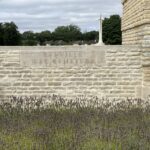
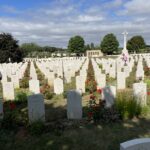
As we stepped beyond the graveyard of locals, we entered the immaculately kept War Cemetery, the last resting place of 2152 British Soldiers including a 16 year old paratrooper. Such a beautiful and peaceful place, it’s hard to imagine the horror these young men faced.


Stopping for lunch overlooking a harbour, gave us time to reflect on what we had so far learned.
This afternoon we were visiting some of the Normandy Beaches, first stop Sword Beach, where we heard the tales of the triumphant landing of 29,000 British troops, suffering relatively few casualties at 630. The soldiers landing and running up the beach, were rallied by a piper, Billy Millen, striding up and down the beach playing his bag pipes. Remarkably he survived and is commemorated with a statue close to the beach.


Moving on to Juno beach, where the majority of troops were Canadian and 3200 vehicles were landed onto the sand. However there were also heavy casualties and almost one third of the landing craft were destroyed. Today there is a Churchill AVRE tank standing guard to the entrance of the beach, together with memorials to the fallen Canadian and Polish soldiers.

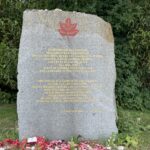
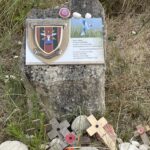
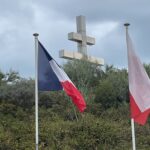
We climbed the dune and down onto the beach itself. Whilst families played on the sand and paddled in the sea, a constant reminder of the French gratitude stood watching over them.

We reboarded our bus, waiting for the odd straggler returning to the raised eyebrows of our guide, and made our way to Ver sur Mer and the British Normandy War Memorial, which was, surprisingly, only opened in 2021. We were advised that it was a bit of a climb up to the memorial that stands looking down towards the beaches, where the waves of allied forces came ashore.
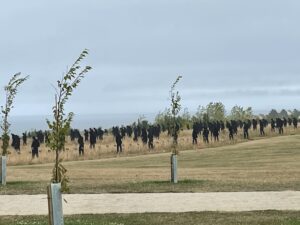
We were prepared for the walk up to the memorial, but although we had come to see it, we weren’t prepared for the impact of the Standing With Giants installation. Rising up from the beaches below, through the meadows to the top of the hill, the sight of 1475 silhouettes, representing the number of British Service killed on D-Day, just took your breath away.

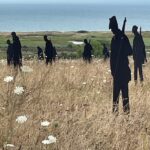
As we wandered amongst the life size silhouettes, the realisation that each one represented someone who had given their lives to secure our future freedom, was slightly overwhelming. Like us, there were lots of visitors, just walking silently, trying to take in the enormity of the losses. Incredibly moving.😢
The British Normandy Memorial, took six years to build and now permanently commemorates 22,442 servicemen who lost their lives during the Battle of Normandy during the Summer of 1944. The majority of these are also buried in or around Normandy. The main commemorative wall, lists those lost on D Day itself and surrounding the memorial there are pillars, listing, in date and alphabetical order, the name, rank and number of all the servicemen that were killed from 7th June 1944 to 31st August 1944. Sadly not every serviceman has a grave stone, but each person is individually remembered here and their descendants will be able to locate their personal tribute for generations to come.

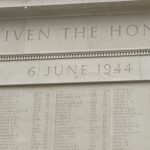
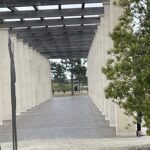


We were so glad that we made the journey. Although it tugs at the heart, it is an incredibly beautiful and thoughtful memorial.
The Standing with Giants installation has been dismantled and is today making its way back to the UK. Im pleased to say it will be on display once more at National Trust’s Stowe Gardens, from 1st October until 11th November and so worth a visit.
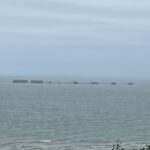
Once again aboard our coach, we were lost in our own thoughts as we headed to our last stop of the day. Arromanches les bains, AKA Gold Beach, was the home of an artificial harbour and port. After the landings, the pontoons were towed across the Channel to build a vast harbour and secure port, enabling more forces to land safely and vehicles and equipment to be brought ashore for the ongoing battles.
Remnants of the harbour can still be seen at sea, and like all the villages and towns we visited, there are memorials and war time vehicles in the town centre as a constant reminder. Despite being two months on from the D Day commemorations, flags and bunting were still hanging throughout the streets.




It had been a long, tiring, emotional and informative day. We had seen and learned so much, but as the rain started to fall, we were glad to be heading back to the hotel for dinner and a nice rest, in preparation for day 2